 blog
blog
Best Facial Treatments in Mystic, CT: 2026 Guide
Table of Contents
- What Makes a Facial Treatment the Best Fit for Your Skin
- Facial Treatment Benefits You Can Expect Beyond a Glow
- How to Choose a Facial: A Practical Decision Framework
- Customized Facial Treatments for Acne, Dryness, and Anti-Aging
- Comparing Popular Facial Types: What Each One Does
- Pricing, Packages, and What Affects Your Total Cost
- Post-Treatment Care and Seasonal Skincare Needs
- Frequently Asked Questions
Last Updated: September 28, 2026
What Makes a Facial Treatment the Best Fit for Your Skin
The best facial treatments mystic ct clients choose are the ones matched to their specific skin concerns, not the trendiest option on a menu. A treatment chosen for your skin type, barrier condition, and goals delivers far more than a generic add-on ever will.
Facial treatments are professional skincare services that combine cleansing, exfoliation, extraction, and targeted actives to improve skin health. The right one depends on what your skin actually needs, not what worked for someone else.
Here is the problem with most spa menus. They list treatments by name and price, but never by skin type or goal. You end up guessing. A client with a compromised skin barrier books a strong exfoliating facial and leaves worse off than when she arrived.
The American Academy of Dermatology's skincare resource library makes the same point: gentle, consistent care beats aggressive treatment for most skin types.
Below, we break down how to choose a facial by concern, what each type actually does, and how to plan for aftercare.
Facial Treatment Benefits You Can Expect Beyond a Glow
Facial treatment benefits go well past a temporary glow. A well-matched facial improves hydration, supports cell turnover, and helps your skin barrier recover from daily stressors.
Expect these outcomes from a properly chosen treatment:
- Cleaner pores with less visible congestion
- Improved hydration that lasts beyond the appointment
- More even tone and texture over a series of sessions
- Calmer redness and irritation for sensitive skin
- Better absorption of your at-home products
What most guides miss is that results compound. One facial helps. A consistent plan, spaced according to your skin's turnover cycle, changes how your skin behaves between visits.
How Clinical Skincare Supports Your Skin Barrier
The skin barrier is the outermost layer of skin that locks in moisture and blocks irritants. When it is compromised, you get dryness, sensitivity, and breakouts that never quite clear.
Clinical skincare supports the barrier by avoiding over-exfoliation and prioritizing ingredients like ceramides, hyaluronic acid, and niacinamide. A skilled aesthetician reads your barrier condition before choosing actives. That is the difference between a facial that helps and one that sets you back.
How to Choose a Facial: A Practical Decision Framework
How to choose a facial comes down to three questions: What is your primary concern, how sensitive is your skin, and how much downtime can you accept? Answer those honestly and the right treatment becomes obvious.
Use this framework before you book:
| Your Primary Concern | Best Facial Type | Typical Downtime | Frequency |
|---|---|---|---|
| Acne and congestion | Deep-cleansing with gentle extraction | Minimal | Every 4-6 weeks |
| Dryness and dullness | Hydrating and barrier-repair | None | Every 4 weeks |
| Fine lines and firmness | Anti-aging with targeted actives | Minimal to moderate | Every 4-6 weeks |
| Redness and sensitivity | Calming and soothing | None | Every 4 weeks |
| Uneven tone and texture | Brightening with mild exfoliation | Minimal | Every 4-6 weeks |
If you are unsure, book a consultation first. Guessing wastes money and can irritate your skin.
Questions to Ask During a Professional Consultation
A professional consultation should cover your history, not just your goals. Ask these questions before any treatment begins:
- What is my skin type and current barrier condition?
- Which ingredients will you use, and why those for my concern?
- How many sessions before I see measurable change?
- What should I avoid in the days after treatment?
- What does a realistic maintenance schedule look like for me?
A provider who skips these questions is guessing. A provider who answers them clearly is building a treatment plan.
Customized Facial Treatments for Acne, Dryness, and Anti-Aging
Customized facial treatments work because acne, dryness, and anti-aging each need a different approach. The same protocol cannot serve all three.
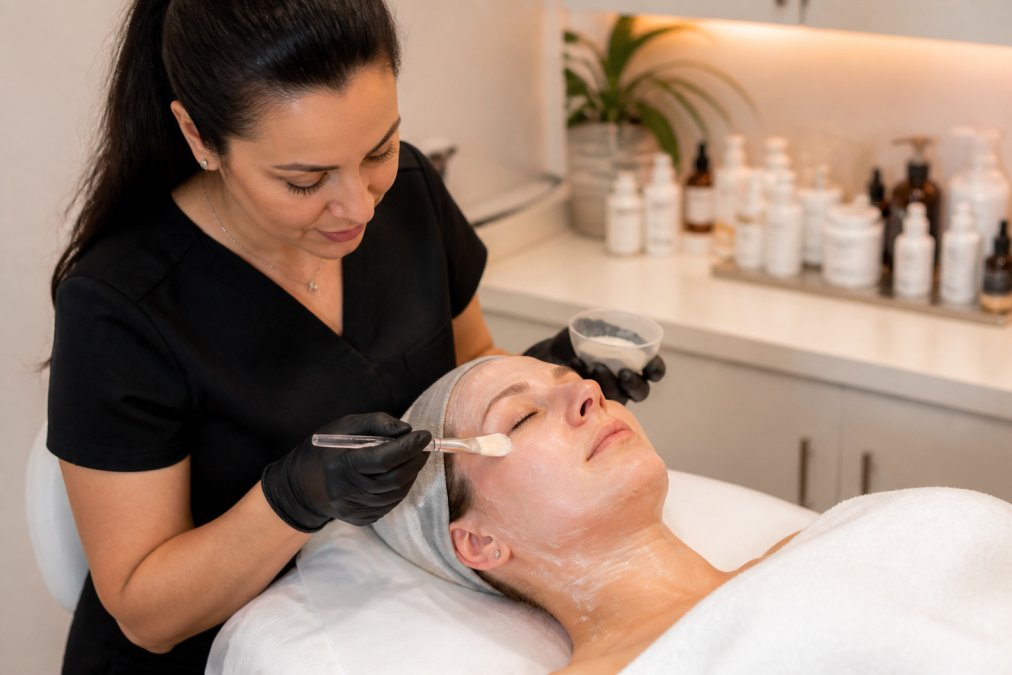
Reading your skin in person beats any online quiz.
Comparing Popular Facial Types: What Each One Does
Popular facial types differ mainly in depth, actives, and downtime. Knowing what each one actually does, and where the line falls between a spa facial and a medical facial, helps you avoid paying for a treatment that does not match your goal.
The Spa Facial vs. the Medical Facial
This is the distinction most menus never explain, and it is the one that matters most when you are choosing.
What Each Popular Facial Type Actually Does
- Classic facial: Cleansing, gentle exfoliation, extractions if needed, and hydration. Best for maintenance and first-timers. Little to no downtime.
- Hydrating facial: Focuses on moisture retention and barrier repair using humectants and emollients. Best for dry, tight, or compromised skin. No downtime.
- Anti-aging facial: Uses targeted actives that support collagen and firmness, sometimes paired with gentle resurfacing. Best for mature skin or early fine lines. Minimal to moderate downtime depending on actives.
- Acne facial: Deep cleansing with careful, controlled extraction. Best for congested, breakout-prone skin. Minimal downtime, though some redness is normal for a few hours.
- Brightening facial: Mild exfoliation targeting tone and texture. Best for dull or uneven skin. Minimal downtime, with increased sun sensitivity afterward.
- Calming facial: Soothing actives and minimal manipulation. Best for reactive or rosacea-prone skin. No downtime.
How to Tell Which Category You Are Booking
Ask three questions before you book:
- Who performs the treatment, and what is their license or credential?
- Is a physician involved in the plan or supervision?
- Is the goal cosmetic maintenance or treatment of a specific condition?
If the answers point to cosmetic maintenance, you are booking a spa facial. If they point to condition-specific treatment with medical oversight, you are booking a medical facial. Both are legitimate, they simply serve different goals, and choosing the wrong one is the most common reason clients feel a treatment "did not work."
Pricing, Packages, and What Affects Your Total Cost
Facial pricing varies widely. Here is a framework for what drives the number up or down, and how to evaluate a package before you commit.
Typical Price Ranges
Exact prices depend on your market, the provider's credentials, and the treatment plan. Always confirm current pricing directly with the provider before booking.
What Drives the Total Up or Down
- Treatment type and actives used. A hydrating maintenance facial costs less than a clinical protocol with medical-grade ingredients.
- Number of sessions in your plan. A single facial is one price; a series is priced differently and often at a per-session discount.
- Add-ons. Each enhancement adds to the base.
- Provider experience and certification. A licensed esthetician with advanced training typically charges more than a newer provider.
- Location and facility type. A medical spa with physician oversight generally prices above a standalone esthetics studio.
How to Evaluate a Package
Packages can save money, but only if you actually need the sessions. Before you prepay:
- Ask for a written plan showing the number of sessions and the total cost.
- Ask what happens if you need to pause or cancel, is the package refundable, transferable, or credit-only?
- Start with one treatment, evaluate how your skin responds, then decide on a series.
Questions to Ask About Price
- What is included in the base price, and what counts as an add-on?
- Is the consultation fee separate or applied to the treatment?
- Do you offer a series rate, and is it refundable?
- Are there any medical-grade options, and are they priced differently?
For current pricing, check the provider's website directly or call the studio, prices change with location, season, and menu updates.
Post-Treatment Care and Seasonal Skincare Needs
Post-treatment care determines how long your results last. The 48 hours after a facial matter as much as the treatment itself.
Follow these steps:
- Skip harsh exfoliants and retinoids for a few days
- Wear sunscreen daily, every day
- Keep the routine simple: cleanse, moisturize, protect
- Avoid intense heat and heavy workouts right after treatment
- Hydrate and let the barrier settle
Frequently Asked Questions
What are the benefits of professional facial treatments?
Professional facial treatments clean out clogged pores, boost hydration, and support your skin barrier with clinical skincare products. Regular sessions can reduce acne breakouts, soften fine lines, and improve overall skin tone. Many people also find facials help their at-home products absorb better because dead surface cells are removed. Results build over time, so a series of sessions usually works better than a single visit.
How often should I get a facial for optimal skin health?
Most estheticians suggest a facial every four to six weeks to match your skin's natural renewal cycle. If you are managing active acne or dryness, a provider may recommend closer spacing at first, then taper to maintenance visits. Your treatment plan should reflect your skin goals, budget, and how your skin responds. A professional consultation is the best way to set a schedule that fits your skin.
What should I look for when choosing an esthetician?
Check state licensure, training, and whether the provider asks about your skin history before recommending anything. Look for someone who offers customized facial treatments rather than a single menu option for everyone. Reviews and before-and-after photos from clients with similar skin concerns are useful signals. A good esthetician explains what each step does and gives you a realistic post-treatment care plan.
How do I prepare for a professional facial appointment?
Stop using retinoids and exfoliating acids for about three to five days before your visit, and skip waxing or shaving the treatment area for 24 hours. Arrive with clean skin if possible, and bring a list of products you use daily. Tell your esthetician about any medications, allergies, or recent procedures. Good preparation helps the provider tailor the session and lowers the chance of irritation.