 listicle
Best Lash Extension Styles for Hooded Eyes in 2026
Table of Contents
- Why Standard Lash Sets Fail on Hooded Eyes
- The 4 Best Lash Extension Styles for Hooded Eyes
- Lash Extension Curl Types for Hooded Eyes: L, M, and D Explained
- Cat Eye vs Doll Eye for Hooded Eyes: Which Wins?
- How Long Do Lash Extensions Last on Hooded Eyes?
- Common Mistakes That Ruin Hooded Eye Lash Sets
- Consultation: Your First Step to the Perfect Set
- Frequently Asked Questions
Last Updated: September 5, 2026
Finding the best lash extension styles for hooded eyes in 2026 requires understanding that your eye shape changes the rules of lash mapping. A hooded lid hides the natural crease, which means the wrong set can close off your eye and make your hard work disappear the moment you open your eyes. At Liz Almanzar Esthetics in Mystic, CT, we specialize in lash extension styles for hooded eyes that create an eye-opening effect while protecting the health of your natural lashes.
Standard sets often fail because they don't account for how the skin fold sits across the lash line. The goal is to choose a style that lifts visually rather than one that follows the natural downward curve of the lid.
Why Standard Lash Sets Fail on Hooded Eyes
The anatomy is the problem. With a hooded eyelid, excess skin rests along the lash line, which means any extension applied at a standard angle gets pushed downward or hidden entirely. Lash line visibility drops, and the eye looks smaller rather than more open.
Many lash artists apply the same mapping to every client, but eye shape analysis is not optional for hooded lids. A classic set with uniform length and curl often collapses into the fold within days.
A technician who understands lash mapping for hooded eyes will measure how much of your lash line is exposed when your eyes are open and relaxed, not just when they are closed on the pillow.
The 4 Best Lash Extension Styles for Hooded Eyes
The best lash extension styles for hooded eyes share one trait: they concentrate length and curl where the eye opens widest. These four mappings consistently create an eye lift illusion that survives blinking, squinting, and daily life.
1. Open-Eye Mapping: The Everyday Lifter
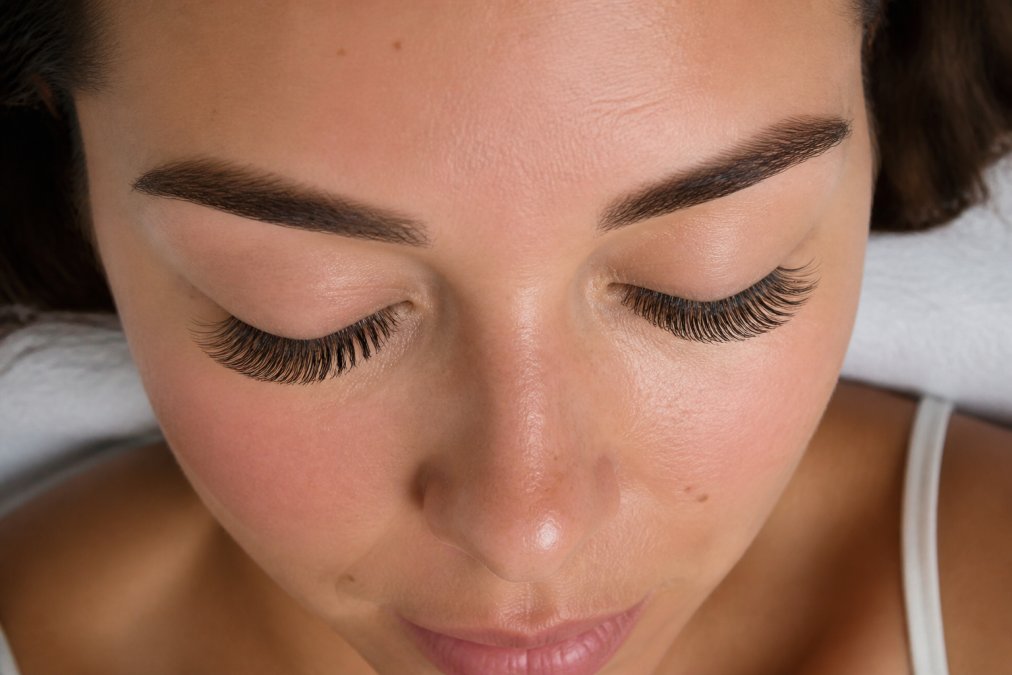
Open-eye styling is the most reliable choice for hooded clients who want a natural look with genuine lift. This mapping places the longest lashes at the center of the eye and gradually shortens them toward both corners.
The center focus draws attention to the widest part of your eye, counteracting the heaviness of the hood. For mature hooded eyes, this style is especially effective because it avoids dragging the outer corner downward.
2. Doll-Eye Effect: Center-Focused Brightening
The doll-eye effect takes center focus further by using longer lengths and a stronger curl at the pupil, creating a rounder, more awake appearance.
Because all the weight sits in the middle, there is no pull on the outer corners, making doll-eye safer for hooded lids prone to drooping. It pairs best with a D-curl to ensure the extension clears the hood.
3. Squirrel Mapping: The Flattering Compromise
Squirrel mapping combines elements of cat-eye and doll-eye by keeping length longest at the center and tapering gently toward the outer corner without extending past the eye, preventing the heavy outer drag that ruins cat-eye on hooded lids.
This is the compromise style for clients who want a subtle lift with a hint of elongation, working particularly well for downturned eyes that also have hoods.
4. Wispy Cat-Eye: The Elongating Option
A traditional cat-eye drags length to the outer corner, which can emphasize the hood and pull the eye down. The wispy cat-eye fixes this by using tapered ends and alternating lengths to soften the outer corner while still creating elongation.
The wispy texture breaks up the solid line of lashes, so the hood has less surface area to press against. This style suits clients who want the eye-lengthening effect but have enough natural lid structure to support it.
Lash Extension Curl Types for Hooded Eyes: L, M, and D Explained
Curl type determines whether the extension clears the hood or disappears into it. For hooded eyes, the L-curl, M-curl, and D-curl are the three that matter most.
The L-curl has a flat base with a sharp, almost 90-degree lift, making it the workhorse for deep hoods and monolids because it rises nearly vertically from the lash line (peer-reviewed research). The flat base sits flush against the natural lash, which helps with retention, but the sharp angle can look spiky if overused. Most practitioners reserve the L-curl for the outer third of the lash line.
The M-curl is a softer evolution of the L, with a more gradual transition from base to tip, meaning it clears the hood without looking as upright. It is often the best choice for moderate hoods and reads as more natural in daylight.
The D-curl provides the most dramatic lift and is the go-to for clients who want a visible eye opening effect. The curve is continuous, meaning it can push against the hood if placed too close to the lash line. For hooded eyes, the D-curl must be placed with precision, slightly more toward the center of the lid, so the curve clears the fold rather than pressing into it.
| Curl Type | Shape | Best For | Watch Out For |
|---|---|---|---|
| L-Curl | Flat base, sharp 90-degree lift | Deep hoods, monolids | Can look too upright if overused |
| M-Curl | Soft base, gentle lift | Natural look, moderate hoods | Less drama than D-curl |
| D-Curl | Strong curve, high lift | Dramatic open-eye effect | Needs precise placement to avoid spiking |
The Mature Hooded Eye: Why Curl Choice Changes with Age
Most guides treat hooded eyes as a static condition, but skin laxity increases over time. As we age, the skin along the upper lid loses elasticity, meaning the hood can become heavier and sit lower on the lash line than it did a decade earlier.
For mature hooded eyes, the L-curl often becomes the safest recommendation. The sharp lift is less likely to be weighed down by the fold, and it provides the most reliable opening effect. The D-curl, while dramatic, can sometimes exacerbate the appearance of heavy lids. A common pattern among experienced lash artists is to use an L-curl at the outer corner and a softer M-curl toward the center for mature clients.
Aging can lead to thinner, more brittle lashes, meaning the curl must be paired with a lighter weight extension. A heavy D-curl fan on a fragile natural lash can cause premature shedding. The L-curl, when applied with a lighter diameter (0.15 mm or less), offers a safer balance between lift and lash health.
Your technician should select curl based on how much lid space you have when your eyes are open, not just when they are closed. A curl that is too flat will hide; one that is too strong can look unnatural or press on the hood.
Cat Eye vs Doll Eye for Hooded Eyes: Which Wins?
For hooded eyes, the doll-eye wins in most cases. The center-heavy placement works with the anatomy instead of against it, delivering the eye lift illusion that most hooded clients are seeking.
The cat eye can work, but only in its wispy form and only for clients with a defined outer corner. When the outer corner is hooded or downturned, extending length there drags the eye down and makes the lid look heavier.
How Long Do Lash Extensions Last on Hooded Eyes?
Lash retention on hooded eyes depends more on aftercare than on the style itself. A full set typically lasts until the natural lash cycle sheds, usually two to four weeks, but clients with oily skin or those who sleep on their faces will see faster fallout (aao.org).
Hooded clients face an extra challenge: the skin fold can trap oil and debris along the lash line, weakening the lash adhesive bond. Using an oil-free cleanser daily and brushing through the lashes keeps the base clean. A fill every two to three weeks maintains the mapping.
Common Mistakes That Ruin Hooded Eye Lash Sets
The most common mistake is choosing a curl that is too flat. Without enough lift, the extension rests under the hood and the client loses the open-eye effect entirely.
Another frequent error is overloading the outer corners. Heavy volume fans placed at the edge of a hooded eye create a drooping appearance and increase the risk of premature shedding. Many technicians also skip the lash mapping step and apply uniform lengths, which flattens the eye shape.
The Mapping Error Most Technicians Miss
A less obvious but equally damaging mistake is failing to account for the "open-eye" lash line. When a client with hooded eyes is lying down with eyes closed, the lash line appears longer and more exposed than it does when they are standing and looking straight ahead. A technician who maps the set entirely on a closed eye will place extensions in areas that are hidden by the hood in real life. The fix is to map with the client sitting upright and looking straight into a mirror, marking where the hood actually falls.
Sensitivity and Allergy Considerations for Hooded Eyes
Hooded eyes are prone to irritation for a structural reason: the skin fold traps heat, oil, and debris along the lash line more readily than non-hooded lids. This makes the area more susceptible to reactions from adhesive fumes, tape, and even the extensions themselves. A common mistake is using standard cyanoacrylate-based adhesives without asking about sensitivity history. For clients with known sensitivities, a low-fume or hypoallergenic adhesive is a safer starting point.
The taping technique also matters. During application, technicians often tape the upper lid to expose the lash line. On a hooded eye, this tape can pull the delicate skin or leave adhesive residue that irritates the area. A gentler approach uses a silicone-based tape or a patch that lifts the hood without stretching the skin. For mature hooded clients, this is especially critical because the skin is thinner and more fragile.
Clients make mistakes too. Rubbing the eyes, using oil-based makeup removers, and skipping daily cleansing all shorten retention. But for hooded eyes, the most overlooked client error is sleeping on the face. The hood already presses against the lashes during the night; adding face-down pressure accelerates fallout and can bend the extensions into an unnatural angle. Encouraging back-sleeping or the use of a silk pillowcase reduces friction significantly.
Consultation: Your First Step to the Perfect Set
A consultation is not a formality. It is where your technician assesses your eye shape, natural lash density, and lifestyle to determine which lash extension styles for hooded eyes will actually work for you.
The American Academy of Ophthalmology guidance on eyelash extensions notes that extensions can cause eye irritation if applied improperly, which is why choosing an experienced provider matters. At Liz Almanzar Esthetics, we build each set around your facial structure and lash health, and we only recommend a style we can maintain safely over time.
If you have had extensions before and they felt heavy or uncomfortable, that is often a placement issue, not a reason to give up. A professional application protects your natural lashes and delivers the low-maintenance routine you are after. Book a consultation with Liz Almanzar Esthetics and let us map a set that opens your eyes, suits your daily routine, and lasts the way it should.
Choosing the right lash extension styles for hooded eyes in 2026 comes down to curl selection, mapping, and honest aftercare. The doll-eye and open-eye mappings deliver the most reliable lift, while the wispy cat-eye works only for specific lid structures. At Liz Almanzar Esthetics in Mystic, CT, we specialize in customized styling that prioritizes lash health alongside the finished look. Get started with Liz Almanzar Esthetics and walk out with a set that makes your eyes look open, bright, and entirely natural.
Frequently Asked Questions
What style of eyelash extensions look best on hooded eyes?
Styles that create an eye lift illusion work best. Open-eye mapping and squirrel mapping are top choices because they concentrate length and curl in the center of the eye, which helps counteract the drooping effect of the eyelid. Avoid heavy, uniform lengths that can drag the eye down. A professional can customize a set for your specific eye shape.
Is C curl or D curl better for hooded eyes?
For most hooded eyes, a D-curl or an L-curl is more effective than a C-curl. A C-curl often doesn't have enough lift to clear the hood, so the lash can point downward and disappear when your eyes are open. L- and M-curls have a straighter base that lifts up at the tip, making them ideal for creating an eye-opening effect.
How do lash extensions change the appearance of hooded eyes?
Lash extensions can make hooded eyes look more open, awake, and symmetrical. By using strategic lash mapping and curl types, they create an eye lift illusion that makes the lash line appear higher. This reduces the visual weight of the eyelid and can make the eyes appear larger without surgery.
What should I avoid when getting lash extensions for hooded eyes?
Avoid lashes that are too long or too heavy, as they can weigh down your natural lashes and worsen the hooded appearance. Steer clear of a dramatic cat-eye look that extends far outward, as this can pull the eye shape downward. Also, ensure your technician avoids gluing lashes to the hooded skin, which can cause discomfort and poor retention.
How long do lash extensions last?
A full set of lash extensions typically lasts through the natural lash growth cycle, which is about 6 to 8 weeks. However, you'll need infills every 2 to 3 weeks to maintain a full look as your natural lashes shed. Hair texture and aftercare habits also play a role in how long each individual extension stays attached.