 ultimate-guide
How to Find the Best Local Esthetician: 2026 Guide
Table of Contents
- Start With a Skin Analysis and Clear Goals
- How to Verify an Esthetician License in Connecticut
- Questions to Ask Your Esthetician Before Booking
- The Benefits of Professional Facial Treatments
- How to Evaluate Reviews and Client Testimonials
- Budgeting for Long-Term Skin Goals
- Post-Treatment Follow-Up Expectations
- Frequently Asked Questions
Last Updated: September 24, 2026
Start With a Skin Analysis and Clear Goals
Finding the right local esthetician starts before you book anything: with an honest look at your own skin and a written list of what you want to change. Liz Almanzar Esthetics, a skincare studio in Mystic, CT, is dedicated to enhancing your natural beauty and delivering an enhanced aesthetic appearance through expert services tailored to your specific needs.
- Your skin type (oily, dry, combination, sensitive)
- Your primary concern (acne, texture, pigmentation, fine lines)
- Your current routine and products, including active ingredients
- Your history: past reactions, medications, and any dermatology referral
How to Verify an Esthetician License in Connecticut
Connecticut requires estheticians to hold a state license, and you can confirm any practitioner's status before you book. Verification takes about five minutes and eliminates most of the risk in choosing a provider.
Checking the State License Lookup
The Connecticut Department of Public Health maintains a license verification system for estheticians and other licensed practitioners. Search the practitioner's full name, confirm the license is active, and check the expiration date. An expired or lapsed license is a hard stop. So is a practitioner who cannot tell you their license number.
Insurance and Liability Coverage
Professional liability insurance is one of the most overlooked checks, and it is exactly the kind of protection you want in place before anyone applies a chemical peel or hot wax to your skin. Ask whether the practitioner carries liability coverage and whether they work as an independent contractor or under a salon's policy. If a treatment causes a reaction or injury, coverage determines who is responsible.
Questions to Ask Your Esthetician Before Booking
The consultation is where you separate a skilled practitioner from a salesperson. Ask direct questions and listen for specific answers rather than vague reassurance.
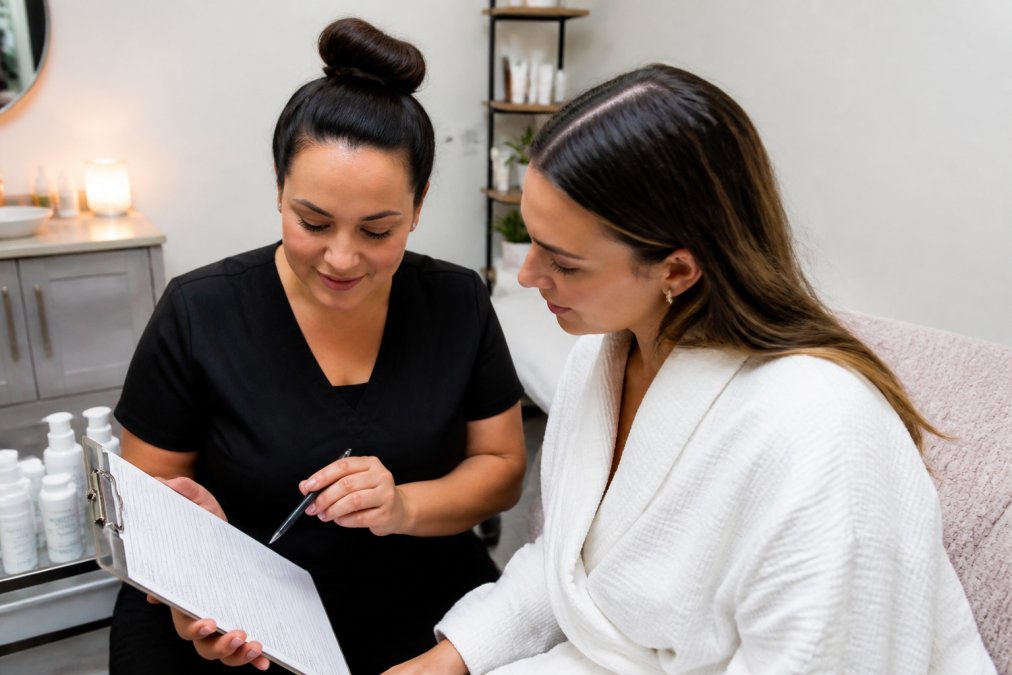
Start with these:
- What is your license number, and what certifications do you hold beyond it?
- How do you decide which treatment suits my skin type?
- What active ingredients will you use, and how will they interact with my current routine?
- How do you handle a reaction during or after treatment?
- What does post-treatment care look like, and who do I contact if something goes wrong?
- Do you refer clients to a dermatologist when a concern is outside your scope?
Sanitation and Spa Hygiene Standards
Sanitation is non-negotiable, and you can assess it in the first two minutes. Look for single-use applicators, freshly laundered linens, and tools pulled from a sterilized or disinfected container in front of you. Estheticians should wash hands before and after treatment and use gloves where appropriate. If a practitioner reuses a wax spatula after it has touched skin, leave. That single habit tells you everything about the sanitation standards in the room.
Red Flags in Product Usage and Contraindications
Contraindications are the conditions or products that make a treatment unsafe, and a good esthetician screens for them before starting. Tell your practitioner about any prescription retinoid, isotretinoin use, recent laser treatment, pregnancy, or known allergies. Then watch how they respond.
Red flags in product usage include:
- Recommending strong exfoliation or a chemical peel on skin that is already irritated or compromised
- Selling a large product package before your first treatment has even been completed
- Failing to ask what you already use at home
- Promising a specific outcome in a fixed number of sessions
The Benefits of Professional Facial Treatments
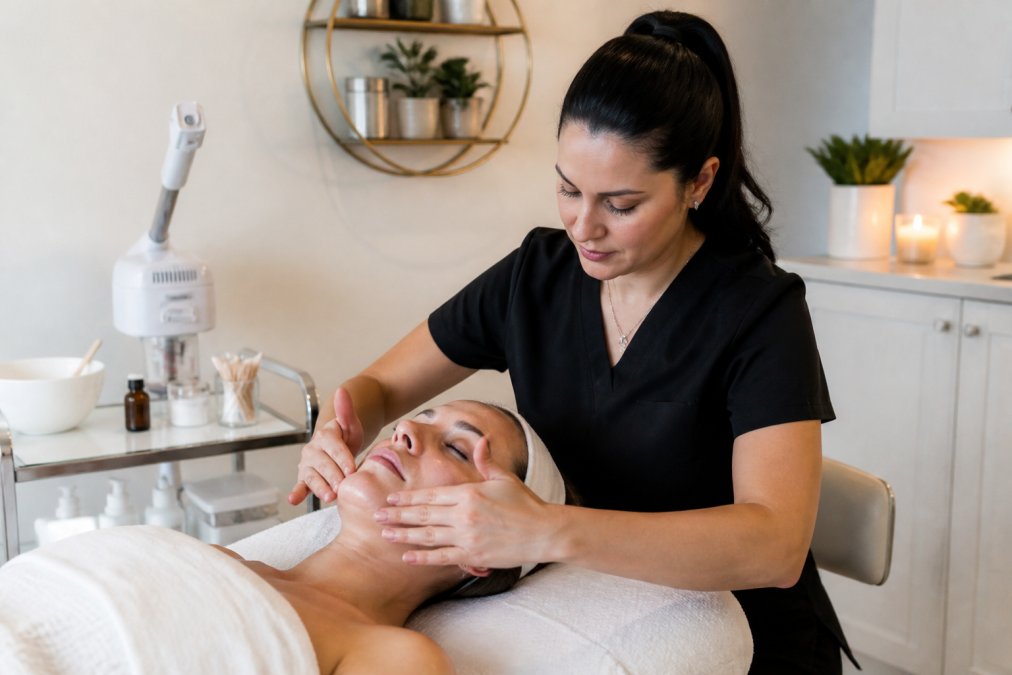
Professional facial treatments deliver results that home care alone rarely matches, mainly because a trained practitioner can assess skin in person and adjust in real time. The benefits of professional facial treatments include deeper cleansing, controlled exfoliation, targeted treatment of active ingredients, and a clear read on what your skin actually needs.
Customization for Acne, Dryness, and Aging
Treatment customization is where professional facials outperform any single product. Acne treatment focuses on pore health, gentle exfoliation, and reducing inflammation without stripping the barrier. Dryness calls for hydration and barrier repair rather than more exfoliation. Signs of aging respond to treatments that support collagen and even tone over a series of sessions.
How to Evaluate Reviews and Client Testimonials
Client testimonials tell you more when you read them for specifics rather than star ratings. A useful review names the treatment, the skin concern, and the outcome. "My acne calmed down after three sessions" is worth more than "amazing experience."
- Timing clusters. A burst of five-star reviews posted within the same week, especially from accounts with no other activity, is a weaker signal than reviews spread naturally across months.
- Treatment specificity. Reviews that name a real service (a hydrating facial, a series of gentle exfoliation sessions) and describe a realistic timeline carry more weight than reviews that only praise the front desk.
- Balanced detail. A reviewer who mentions a small downside, a wait, a product that stung, and still recommends the practitioner is usually describing a genuine visit.
- Photo consistency. Before-and-after photos should show the same lighting, the same angle, and a range of skin types and tones. If every photo looks like it came from the same polished shoot, ask whether the results are representative.
Cross-Checking Reviews Against Public Records
The strongest verification step most clients skip is comparing what a studio claims online against what public records actually show. Reviews describe the experience; records describe the practitioner. Do both.
- Confirm the license status through your state's professional licensing board lookup, and check that the name on the review page matches the name on the license.
- Search your state's consumer protection or attorney general complaint database for the studio name.
- Check whether the business appears on the Better Business Bureau and how it has responded to any complaints, a thoughtful response to a bad review tells you more than a perfect rating.
- If the studio advertises a specific modality (medical-grade peels, microneedling, LED), verify that the practitioner holds the certification the modality requires, not just a general esthetics license.
Budgeting for Long-Term Skin Goals
Skin results come from consistency, so plan your spending across months rather than a single visit. Most guides treat a facial as a one-time purchase; the clients who actually see lasting change treat it as an ongoing maintenance cost, the same way they budget for haircuts or dental cleanings.
A workable framework has three buckets:
- Treatment sessions. How often you need to come in depends on your concern. Active acne or post-inflammatory pigmentation often calls for sessions spaced two to four weeks apart during an initial correction phase, then tapering to every four to eight weeks for maintenance. Signs of aging and general barrier health usually respond to a maintenance cadence of every four to six weeks. Ask your esthetician to map the cadence before you commit, and ask what the tapering schedule looks like once your skin stabilizes.
- Home care. A practitioner will typically recommend a short routine, a gentle cleanser, a moisturizer, a sunscreen, and one or two targeted actives. Resist the urge to buy the entire shelf at once. A common pattern is to introduce one new active at a time so you can tell what is working and what is irritating your barrier.
- Buffer for adjustments. Skin changes with seasons, stress, travel, and medication. Set aside a small monthly cushion so a plan change does not force you to skip a session or abandon a routine mid-course.
Questions That Reveal Whether a Plan Is Real
Before you commit to a series, ask your esthetician to outline a realistic treatment timeline with costs. Then ask these:
- What is the total cost of the first phase, and what does maintenance cost after that?
- Which sessions are essential and which are optional add-ons?
- If my skin does not respond as expected, how does the plan change, and does the cost change with it?
- What can I do at home to reduce how often I need to come in?
Where the Money Actually Goes
It helps to understand what you are paying for. A treatment price covers the practitioner's time, the products used in the room, the cost of maintaining a sanitary environment (single-use applicators, disinfected tools, fresh linens), and the practitioner's liability insurance and continuing education. When one studio is dramatically cheaper than another for the same service, the difference is usually in one of those line items, often the products or the sanitation supplies. That is worth asking about directly.
The cheapest path to clear, healthy skin is a realistic plan you can sustain for six months, not an intensive series you abandon after three weeks. Budget for the maintenance phase, not just the correction phase.
Post-Treatment Follow-Up Expectations
Good aftercare does not end when you leave the room. Ask what to expect in the first 24 to 48 hours: mild redness, tightness, or light flaking is common after exfoliating treatments, while severe pain, blistering, or spreading rash is not and warrants a call.
Frequently Asked Questions
How can I verify an esthetician's license in Connecticut?
Connecticut requires estheticians to hold a valid license through the Department of Public Health. You can verify a license by searching the state's online license lookup using the practitioner's name or license number. Ask to see the license displayed in the treatment room. A legitimate local esthetician will have no problem showing proof. If a provider hesitates or cannot produce a license, treat that as a serious red flag and look elsewhere.
What questions should I ask your esthetician during a consultation?
Ask about their training, how they assess skin type, what products they use, and how they handle adverse reactions. Inquire about their experience with your specific skin concerns, whether they carry liability insurance, and what post-treatment care they recommend. A skilled esthetician will welcome these questions and explain their approach clearly. If they rush you or dismiss your concerns, that tells you something important about how they will treat your skin.
What red flags should I look for when choosing a skincare professional?
Watch for dirty tools, reused wax sticks, unlabeled products, and a provider who skips a skin analysis before treatment. Be cautious if they promise permanent results, diagnose medical conditions, or push expensive product packages without explaining why. A clean, licensed practitioner who asks about your health history and contraindications is a much safer choice than someone offering deep discounts with no consultation.
How often should I schedule professional facials for optimal results?
Most estheticians recommend a facial every four to six weeks to match the skin's natural renewal cycle. If you are treating acne, dryness, or signs of aging, your provider may suggest a series of treatments spaced closer together at first, then transition to maintenance visits. Your exact schedule depends on your skin concerns, the treatments used, and how your skin responds. Ask your esthetician for a realistic timeline during your consultation.
Choosing a local esthetician comes down to verification and fit: a confirmed license, real insurance, honest answers in the consultation, and a plan built around your skin rather than a package. Liz Almanzar Esthetics offers facials, waxing, and lash extensions in Mystic, CT, with treatment plans tailored to your specific concerns and a professional, welcoming environment. Get started with Liz Almanzar Esthetics and book a consultation built around your skin goals.