 how-to
How to Treat Dry Skin: A Local Guide
Table of Contents
- Understand the Causes of Dry Skin in Your Environment
- Recognize Signs of Dehydrated Skin
- Build a Daily Skincare Routine for Dry Skin
- Professional Facial Treatments for Dry Skin
- Key Ingredients to Look for in Skincare Products
- Lifestyle Habits That Support Skin Hydration
- When to See a Dermatologist or Skin Care Professional
- Frequently Asked Questions
Last Updated: September 27, 2026
Understand the Causes of Dry Skin in Your Environment
Your environment plays a significant role in dry skin. Coastal conditions create unique challenges that generic skincare advice often overlooks.
Coastal Environmental Stressors
Salt spray deposits sodium chloride crystals that pull moisture from skin through osmotic pressure. Wind accelerates transepidermal water loss by disrupting the skin barrier's lipid layer. Coastal humidity fluctuates dramatically, morning fog creates temporary spikes, but afternoon winds and temperature swings drop relative humidity rapidly.
Constant humidity shifts force your skin to recalibrate oil production, often resulting in combination skin that feels tight in some areas and oily in others.
Indoor Heating and Winter Dryness
Furnaces pull moisture from indoor air, dropping relative humidity to 15-25% in winter, well below the 30-50% range where skin remains comfortable. At these levels, skin loses water vapor faster than it can replenish it.
Heated air accelerates evaporation of topical moisture, which is why routines often "stop working" in winter, the environment overwhelms the product.
Water Quality and Mineral Content
Hard water contains dissolved minerals that interact with soap and moisturizers, leaving a film that blocks hydration and traps bacteria. If skin feels tight after moisturizing, hard water may be the culprit.
Hot showers strip sebum that protects your skin barrier. A 15-minute hot shower can trigger visible dryness within hours for people with dry skin.
Seasonal Transitions
Fall and spring are challenging because temperature and humidity swing wildly. If you don't adjust your routine during seasonal transitions, skin often reacts with increased dryness or sensitivity.
Understanding these specific environmental stressors helps you choose the right treatment approach. It's not just about slapping on moisturizer; it's about addressing what's actually causing the problem in your specific climate.
Recognize Signs of Dehydrated Skin
Dehydrated skin lacks water, not oil. This distinction matters because treatment depends on understanding what you're actually dealing with.
Common signs include:
- Tight, uncomfortable feeling even after moisturizing
- Flaky patches that appear suddenly
- Fine lines becoming more pronounced
- Dull, lackluster appearance
- Itching or sensitivity to products you normally tolerate
Dehydrated skin can look oily in some zones while being dry in others, as skin overproduce oil to compensate for lack of water.
Pay attention to how your skin feels versus how it looks. Tight skin that feels uncomfortable is your signal that hydration is the priority, not oil control.
Build a Daily Skincare Routine for Dry Skin
To treat dry skin effectively, follow a simple principle: cleanse gently, hydrate deeply, and protect constantly.
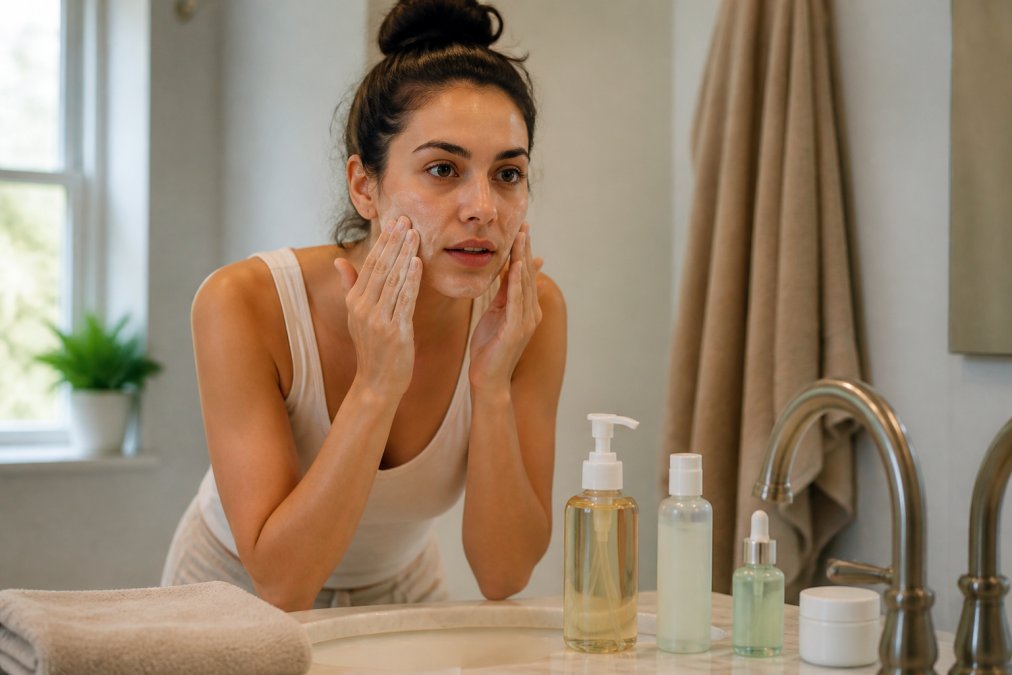
Step 1: Cleanse Gently Without Stripping
Use a gentle cleanser that won't strip your skin barrier. Avoid anything labeled "clarifying" or "exfoliating" if your skin is actively dry.
Look for cleansers that don't foam excessively, rinse clean without residue, feel moisturizing after use, and contain minimal fragrance.
Use lukewarm water, not hot. Lukewarm water cleanses effectively without accelerating water loss or triggering tightness.
Massage gently for 30-60 seconds without scrubbing. Pat dry with a soft towel, leaving skin slightly damp.
Step 2: Apply Hydrating Serums and Treatments
Serums add water back into skin and penetrate deeper than creams alone.
Look for hydrating serums containing hyaluronic acid (holds up to 1000x its weight in water), glycerin, niacinamide, or peptides.
Apply 2-3 drops of serum to damp skin immediately after cleansing. Press gently and wait 30 seconds before the next step.
Step 3: Moisturize While Skin Is Damp
Apply moisturizer to damp skin, not dry skin. Damp skin absorbs better and traps water molecules against your skin surface.
Choose a moisturizer matching your skin type: rich creams for dry sensitive skin, lightweight creams for combination dry skin, occlusive ointments for very dry skin at night.
Emollients (ceramides, fatty acids) fill gaps in your skin barrier. Occlusives (petrolatum, oils) seal moisture in. You need both for treating dry skin.
Press moisturizer gently into skin rather than rubbing to improve absorption and distribution.
Step 4: Protect Your Skin Barrier with SPF
Sun exposure damages your skin barrier and accelerates water loss. SPF protection is non-negotiable for treating dry skin.
Use broad-spectrum SPF 30 or higher daily, even on cloudy days (the American Academy of Dermatology). UV rays penetrate clouds and reflect off water and snow.
Use mineral sunscreens if your skin is sensitive, as chemical sunscreens can irritate dehydrated skin. Reapply every two hours if outside or after swimming.
Professional Facial Treatments for Dry Skin
Professional treatments accelerate results by using techniques and concentrations impossible to replicate at home.
Why Professional Treatments Outperform At-Home Care
Professional hydrating facials target multiple skin layers simultaneously using medical-grade serums with concentrations 2-5 times higher than over-the-counter products and occlusion techniques that force deeper penetration.
Professionals use gentle enzymatic exfoliants or light chemical peels (10-15% glycolic or lactic acid) that remove dead cells without damaging the barrier, often producing visible improvement within 24 hours.
Gentle facial massage increases blood flow, improving nutrient delivery and helping skin absorb and retain hydration for days after treatment.
Typical Professional Hydrating Facial Protocol
Professional hydrating facials typically include gentle cleansing, gentle exfoliation, layered hydrating serums, an intensive mask (10-15 minutes), facial massage, and moisturizer with SPF. The 60-minute process combines professional-grade products, proper timing, and techniques that maximize absorption.
Affordable At-Home Remedies vs. Professional Services: When to Invest
Start with at-home care for mild dryness (flaky patches, slight tightness) that developed recently. Layer hydrating serums before moisturizer, apply moisturizer to damp skin, use a humidifier during sleep, and adjust water temperature. These approaches cost $30-80 monthly and often resolve mild dryness within 3-4 weeks.
Seek professional treatment if at-home care shows no improvement after 4-6 weeks, dryness is accompanied by itching or redness, or you want faster results.
Professional Treatment Frequency and Maintenance
Weekly treatments for 4-6 weeks establish a baseline for moderate to severe dryness, strengthening your skin barrier and resolving visible symptoms.
Key Ingredients to Look for in Skincare Products
The ingredient list tells you whether a product will actually help treat dry skin. Marketing language means nothing; what matters is what's actually in the bottle.
Priority ingredients for dry skin:
Hydrating ingredients:
- Hyaluronic acid, the gold standard for water retention
- Glycerin, pulls moisture into the skin
- Sorbitol, another humectant that draws water
- Aloe vera, soothes and hydrates
Barrier-supporting ingredients:
- Ceramides, fill gaps in the skin barrier
- Cholesterol, supports barrier function
- Fatty acids, nourish and protect
- Niacinamide, strengthens barrier and reduces water loss
Soothing ingredients:
- Centella asiatica, reduces irritation
- Chamomile, calms inflammation
- Oat extract, gentle and hydrating
Lifestyle Habits That Support Skin Hydration
Your daily choices impact your skin's hydration as much as the products you use. Small changes add up to noticeable results.
Adjust your environment:
- Use a humidifier in winter months
- Take shorter, lukewarm showers
- Avoid prolonged exposure to harsh wind
- Limit time in chlorinated pools without protection
When to See a Dermatologist or Skin Care Professional
Most dry skin improves with consistent treatment at home and professional facials. But some situations require a dermatologist or medical professional.
See a dermatologist if:
- Dry skin doesn't improve after 4-6 weeks of treatment
- You develop severe itching, cracking, or bleeding
- The dryness is accompanied by rash or unusual symptoms
- You suspect an underlying condition like eczema or psoriasis
- Your skin reacts poorly to multiple products
| Treatment Approach | Best For | Timeline | Commitment |
|---|---|---|---|
| At-home routine | Mild dryness, prevention | 3-4 weeks to see results | Daily, 10 minutes |
| Professional facials | Moderate to severe dryness | 4-6 weekly treatments | Monthly maintenance after |
| Dermatology care | Persistent or severe cases | Varies by condition | As recommended by provider |
| Combination approach | Best overall results | 2-3 weeks | Daily routine + monthly facials |
Frequently Asked Questions
What ingredients should I look for in a moisturizer for dry skin?
Look for humectants like hyaluronic acid and glycerin, which draw water into the skin, and emollients like ceramides and oils that soften and smooth. Occlusives such as petrolatum or plant-based butters seal moisture in. For sensitive skin, avoid fragrance and alcohol. A dermatologist can recommend specific products suited to your skin barrier's needs.
How do professional facials help with treating dry skin?
Professional facial treatments for dry skin use specialized techniques and medical-grade products to deeply hydrate and repair your skin barrier. Facials can include hydrating serums, nourishing masks, and gentle exfoliation to remove dead skin that blocks moisture absorption. Regular treatments help maintain skin health and address persistent dryness that at-home routines alone may not resolve.
When should I see a dermatologist for persistent dry skin?
See a dermatologist if your dry skin doesn't improve after two weeks of consistent home care, causes significant discomfort, or is accompanied by redness, itching, or scaling. A dermatological consultation can rule out underlying conditions like eczema or psoriasis and provide prescription treatments if needed. Persistent dryness may require professional intervention beyond over-the-counter products.
What are the signs of dehydrated skin I should watch for?
Signs of dehydrated skin include tightness, flaking, dull appearance, and fine lines that worsen throughout the day. You may notice your skin feels uncomfortable after cleansing or that makeup applies unevenly. Dehydrated skin can feel rough to the touch and may show increased sensitivity. If you notice these signs, focus on hydrating serums and moisture-locking products to restore your skin barrier.